
How Many Ingredients Does a Hand Cream Actually Need?

Updated: Oct 7
Walk into the skincare aisle and you’ll find hand creams with ingredient lists ranging from relatively short to surprisingly long.

That can leave you wondering:
Does a longer ingredient list mean a better hand cream?
The short answer is: not necessarily.
But the more interesting question is what all those ingredients are actually doing.
A hand cream has a fairly simple job
At its most basic, a hand cream needs to make your hands feel comfortable and moisturised.
But creating a product that does that well involves more than simply mixing together a few oils and butters.
A formulation needs ingredients that perform different jobs.
For example, you might need ingredients to:
provide moisture
soften and condition the skin
give the cream its texture
help oil and water stay together
protect the formulation from microbial growth
adjust the product's pH
provide fragrance, if fragrance is wanted
So even a relatively simple cream can contain several different types of ingredients.
The interesting part is that simplicity doesn't mean ignoring those requirements.
It means understanding them.
So why do some hand creams contain so many ingredients?
There are lots of perfectly reasonable answers.
Different ingredients can provide different characteristics.
One might improve the feel of the cream. Another might influence how quickly it absorbs. Another might help create a particular texture or appearance.
A manufacturer may also have particular formulation, manufacturing, packaging or sensory requirements to consider.
And some products are designed to do considerably more than simply moisturise hands.
So a long ingredient list isn't automatically a problem.
Equally, a short ingredient list isn't automatically a guarantee of a better product.
The ingredient count alone doesn't tell the whole story.
What matters is what each ingredient is doing
This is where things get more interesting.
Imagine you have two hand creams.
One contains 20 ingredients.
The other contains 8.
Can you immediately say which one is better?
Not really.
You would need to understand what those ingredients are, why they are there and how the formulation works as a whole.
A shorter list can make a formulation easier to understand, but it doesn't automatically make the product more effective.
Likewise, adding another ingredient doesn't automatically make a formulation better.
The question we find more useful is:
What does this ingredient contribute?
This is where formulation becomes a balancing act
Creating a cream isn't simply a case of choosing a collection of good ingredients.
The ingredients have to work together.
Changing one component can affect the texture, stability, feel or performance of the finished product.
That's why formulation is as much about what you leave out as what you put in.
If an ingredient doesn't have a meaningful role, you can reasonably ask whether it needs to be there.
And if an ingredient does have an important role, removing it simply to make the ingredient list shorter doesn't necessarily make sense either.
Simple doesn't mean minimal at all costs.
It means purposeful.
So why does Bare Harmony use a maximum of 10 ingredients?
This is where our own approach comes in.
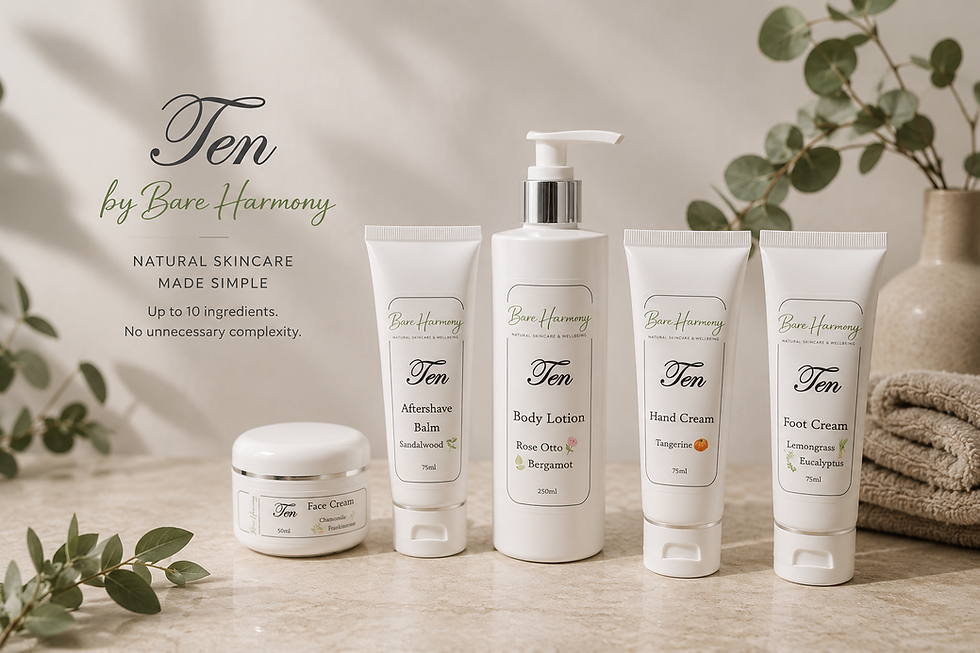
When we developed the Ten range, we deliberately set ourselves a maximum of 10 ingredients for each skincare product.
The number isn't intended to suggest that 10 is the perfect number of ingredients for every hand cream, or that anything above 10 is somehow wrong.
It's a design constraint.
It makes us ask a useful question throughout development:
Does this ingredient really need to be here?
That question helps keep the formulation focused.
It also means that when we talk about an ingredient, there's a reason for talking about it.
Fewer ingredients can make the conversation easier
There's another benefit to keeping formulations relatively simple.
They can be easier for customers to explore and understand.
You don't need to become a cosmetic chemist to be interested in what's in your skincare.
You should be able to look at an ingredient and ask:
What is it doing here?
That's one of the reasons we've created the Bare Harmony Ingredient Library.
Rather than simply giving you a list of names, we're trying to make it easier to understand the ingredients we use and the role they play in our products.
Because we think understanding your skincare is more useful than simply being told that it's "good."
The important bit: there isn't a magic number
If you've taken anything from this article, hopefully it's this:
There isn't a magic ingredient count that makes a skincare product good or bad.
A well-formulated product with 20 ingredients isn't necessarily inferior to one with 10.
And a product with 5 ingredients isn't automatically superior to one with 15.
What matters is what those ingredients are doing, how they work together and whether the finished formulation achieves what it was designed to do.
For us, limiting the Ten range to a maximum of 10 simply provides a useful discipline.
It makes us question every addition.
And sometimes, the most useful question a formulator can ask isn't:
What else could we add?
but:
Do we actually need it?
A thought for your next skincare purchase
Next time you pick up a hand cream, have a look at the ingredient list.
Don't worry about whether it's long or short.
Instead, ask yourself:
What is each ingredient there to do?
You don't need to know the answer to every one.
But asking the question might make you look at skincare a little differently.
And that's really what we're trying to encourage at Bare Harmony.
Not that you should use fewer products.
Not that every other approach is wrong.
Just that understanding what you're choosing can make choosing easier.


Comments